
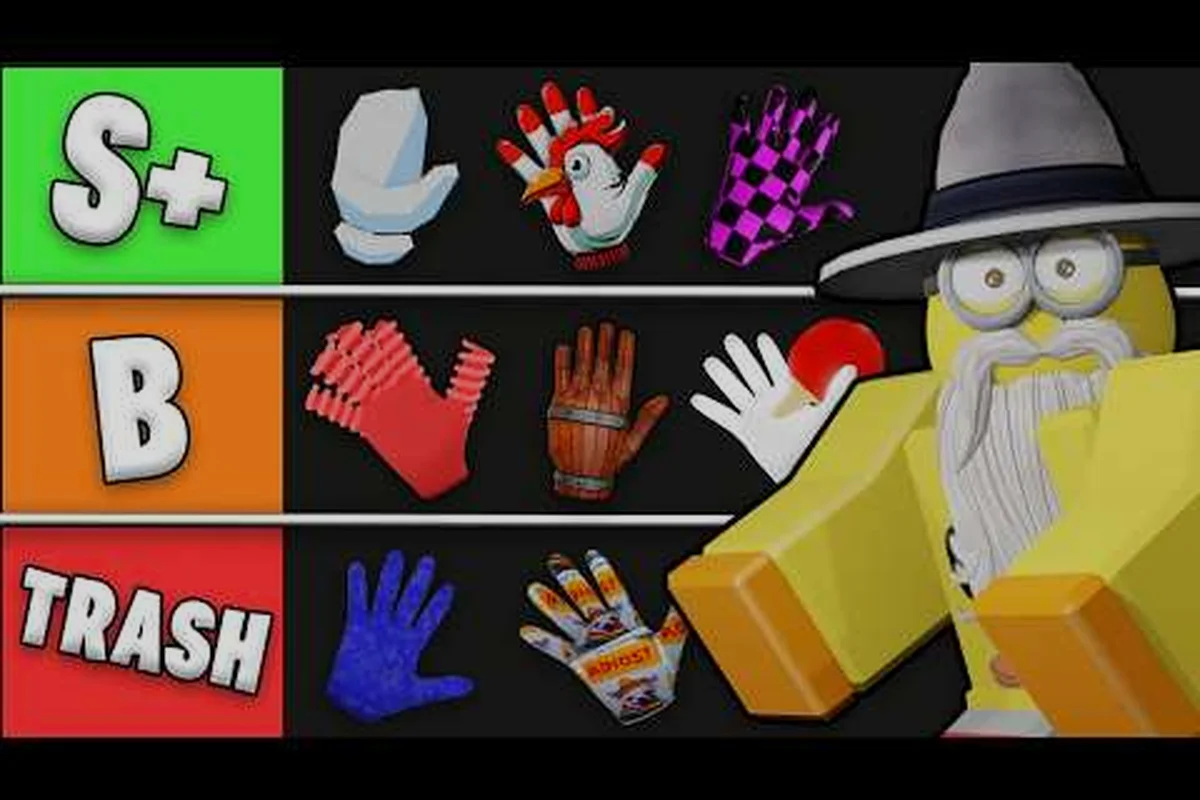
This slap battles all gloves ranked guide evaluates every glove through raw slap power, activation speed, ability utility, and mastery potential rather than rarity alone. A top-tier glove can dominate the meta when its cooldown and passive effects translate into reliable pressure, while a weaker option may still suit beginners who value simple timing or survivability. Compare each pick against the slap battles glove tier list 2026 to identify competitive standouts, then check slap battles best gloves to main recommendations to choose a weapon that matches your preferred playstyle.
Slap Battles All Gloves Ranked: Tier Structure and Evaluation Criteria
A useful slap battles all gloves ranked guide needs more than a long list of names. Gloves can feel dominant in a private server, perform well as a beginner-friendly carry, or lack the consistency required for competitive matches. The 324-glove catalog referenced by natesfate’s ranking project is large enough that individual impressions can become misleading without a shared evaluation framework.
This ranking therefore uses the Slap Battles glove tier list 2026 concept: a practical classification based on competitive impact, not purchase price or visual rarity. The goal is to identify the slap battles top tier slap gloves, while also recognizing dependable picks that remain useful when a premium option is unavailable.
| Tier | Competitive meaning | Typical role | Main recommendation |
|---|---|---|---|
| S | Exceptional impact with few practical drawbacks | High-priority mains and tournament picks | Learn the top gloves first |
| A | Strong, dependable choices with small tradeoffs | Ranked matches and team play | Safe main choices |
| B | Viable with better timing, positioning, or support | Flexible rosters and specialists | Valuable secondary picks |
| C | Functional but limited by clear weaknesses | Learning and low-pressure matches | Upgrade targets |
| D | Situational or easily disrupted | Memes, niche builds, experimentation | Avoid as a primary main |
The supplied community video covers all 324 gloves and masteries, which gives a useful reference for coverage, but final placement still requires judgment. In the full Slap Battles glove ranking by natesfate, the creator compares power, speed, abilities, and tier placements. Treat those observations as community data, especially because balance may shift with updates or platform differences.
What makes competitive glove viability
Competitive glove viability is the combination of damage output, speed, reach, special effects, resource demands, and the margin for error under pressure. A top glove does not need the largest theoretical number in every category. It must provide a meaningful advantage when a player makes a realistic mistake, such as a late dodge or an imperfect angle.
A beginner-friendly glove usually rewards the user with straightforward timing, readable animations, and forgiving recovery. By contrast, a tournament specialist may demand tighter execution, yet it can dominate a duel when used correctly. That is why a single ladder-like ranking can misrepresent the game; separate raw strength from ease of use and matchup reliability.
Ranking labels at a glance
These labels assess each glove’s role through match outcomes, exchange impact, consistency, range, reach, speed, and matchup fit rather than unsupported exact damage or speed statistics. For example, a Top Impact glove may be decisive because its damage and reach create favorable slap timing, while a Specialist glove can outperform it in close-range exchanges but offer little value outside that matchup. This behavior-based approach also distinguishes a Reliable glove for new-player use from a Situational glove whose reward depends on the right setup.
| Label | Meaning | Evidence used | Practical question |
|---|---|---|---|
| Top impact | Wins exchanges when played correctly | Damage, speed, ability, reach | Can it decide a round? |
| Reliable | Performs consistently without extreme mastery | Low risk and stable output | Can a new player use it? |
| Specialist | Strong in a defined situation | Matchup, range, or playstyle fit | Does its use case appear often? |
| Situational | Usable with the right setup | Niche conditions or limited uptime | Is the reward worth the risk? |
| Low priority | Rarely changes a match | Weakness, delay, or poor scaling | Is there a better upgrade? |
Because no authoritative public source in the supplied data gives an exhaustive spreadsheet of every glove’s exact damage and speed values, this article does not invent them. The ranking instead evaluates patterns reported by players and visible in the community ranking project. The 324-glove scope remains the central fact; individual balance should be checked against the current game version before making a final main decision.
S-Tier Gloves and the Best Gloves to Main
The most competitive choices combine meaningful damage with enough speed to punish missed reactions. A giant damage number cannot compensate for an awkward recovery if opponents can repeatedly interrupt the attack. The strongest entries in slap battles all gloves ranked are therefore those that create an advantage in several exchanges rather than relying on a single ability.
The slap battles best gloves to main decision should also consider the player’s experience. Some gloves are excellent tournament tools but demand precise spacing and short decision windows. Others trade a smaller damage ceiling for a simpler attack pattern, making them easier to learn and still effective at higher levels.
Top-impact characteristics
The best top-tier gloves tend to have at least three of these qualities. In a ranked matchup, a glove can edge out higher-rated alternatives by combining quick startup with dependable neutral damage, while reliable reach creates safer opportunities to land a hit. A well-defined counter window also matters: if an opponent’s block or dodge leaves them open, the glove can convert defense into damage instead of granting a free reset. These qualities are especially valuable across the complete 324-glove pool, where raw rarity does not guarantee consistent performance.
-
Fast first contact, which reduces the opponent’s time to react.
-
Strong neutral damage, meaning the glove remains useful without relying on a special ability.
-
Reliable reach, allowing a player to connect from a slightly safer distance.
-
A punishing counter window, so blocking or dodging does not produce a free hit.
-
Low dependence on luck, since consistency matters more than a rare spectacular moment.
-
Practical mastery requirements, because difficult execution is acceptable only when the payoff is clear.
A compact comparison makes the selection easier by weighing startup speed, neutral damage, reach, counter punish, consistency, and mastery demands together, rather than treating one stat as decisive. For example, a glove with slightly less raw damage can rank higher in slap battles all gloves ranked lists if its first contact closes space before the opponent reacts and its punish window remains reliable after a block or dodge. This also explains why the 324-glove pool favors adaptable profiles: a balanced top-tier glove may outperform a higher-rated specialist when its toolkit produces more usable neutral situations.
| Profile | Best use | Main advantage | Main drawback |
|---|---|---|---|
| Aggressive speed specialist | Close-range duels | Punishes slow reactions | Can require aggressive positioning |
| Balanced high-impact glove | Ranked and casual play | Works across more matchups | May lack a dramatic specialty |
| Counter-oriented glove | Reactive play | Rewards precise reads | Less rewarding when timing is poor |
| Ability-heavy glove | Experimentation | High expressive ceiling | May depend on difficult setup |
| Beginner carry | Learning the game | Clear timing and recovery | Usually less dominant in optimized duels |
For a broader look at the most prominent picks, the separate Slap Battles tier list overview concentrates on the strongest and most relevant gloves instead of presenting every entry. That is useful for establishing a shortlist, while this article keeps attention on the complete 324-glove context.
Choosing a main by confidence level
Choose your main according to the number of situations in which you expect to use it. A high-confidence main should be comfortable in open duels, crowded rooms, and imperfect conditions. A lower-confidence main can shine in a specific matchup, although it is less suitable for a first serious main.
Hands-on mastery is a separate advantage. Even an S-tier glove can feel inconsistent when its activation condition is misunderstood. Players who can reliably use the glove’s special effect may extract more value than someone using the same glove at random. The community ranking video’s focus on glove-and-mastery combinations reinforces that point: the equipment is part of a larger build, not an isolated icon.
A-Tier Gloves: Competitive Picks With Clear Tradeoffs
A-tier gloves form the practical foundation of a strong roster. They are not necessarily less expensive or less exciting than S-tier choices, but they tend to sacrifice a small amount of speed, range, consistency, or flexibility. In practice, that tradeoff is often easier to manage than learning a glove whose basic attacks are already difficult to land.
These are strong choices for slap battles glove viability because they remain effective without perfect play. They can be used for grinding, experimentation, ranked preparation, and team compositions that do not require a specific top-tier pick. Some may even outperform S-tier gloves against a less suitable opponent.
Evaluating consistency over peak damage
Peak damage is easy to notice, while consistency determines how often a player can convert opportunities in a Slap Battles glove matchup. Before committing to a glove in the slap battles all gloves ranked list, test how it behaves during three common situations: after a blocked swing, during a rapid neutral exchange, and against an opponent who changes spacing. These checks expose whether the glove’s speed, reach, and special effect can be repeated instead of relying on one high-damage opening.
-
Neutral exchange: Can you land consecutive hits when neither side has an established advantage?
-
Defensive recovery: After missing or being blocked, can you reset without a long delay?
-
Opponent pressure: Does the glove still work when the enemy keeps changing distance?
A glove that wins the neutral exchange but has poor recovery may belong below a steadier A-tier option. Another option may feel weaker in a showcase clip yet rank higher because its usable timing window is wider. This is where the slap battles competitive glove ranking becomes more meaningful than a raw damage comparison.
| Evaluation point | S-tier tendency | A-tier tendency | What to test |
|---|---|---|---|
| Damage | Exceptional ceiling | Strong but not dominant | Does the advantage repeat? |
| Speed | Very fast | Competitive | Can you punish a sidestep? |
| Reach | Generous | Consistent | Does spacing feel natural? |
| Special effect | Decisive when activated | Useful and understandable | Is activation reliable? |
| Recovery | Efficient | Stable | How costly is a miss? |
| Learning curve | Higher | Moderate | Can you use it under pressure? |
Reliable mains versus specialists
A reliable A-tier main is usually the best choice for a player who wants stable progress. It broadens the number of favorable matchups and leaves more room for decision-making. A specialist should be selected for deliberate reasons, such as enjoying a particular range, building around a mastery, or dominating a repeated matchup.
The distinction matters when evaluating slap battles best gloves to main. A tournament player may value a high-ceiling specialist, while a new player may benefit more from a forgiving carry. The competitive glove selection guide provides additional context for pressure situations, where activation timing and opponent awareness carry extra weight.
| Main goal | Preferred profile | Why it works |
|---|---|---|
| Enter tournaments | High-impact, dependable pick | Reduces risk across unpredictable opponents |
| Improve fundamentals | Forgiving attack timing | Makes spacing and dodges easier to learn |
| Test team builds | Specialist with clear role | Adds a reason for teammates to accommodate your pick |
| Play casually after a loss | Lower-pressure A-tier option | Preserves confidence and lets you practice the matchup |
| Chase peak performance | S-tier or unique specialist | Rewards mastery with the highest ceiling |
B, C, and D-Tier Gloves: Where Value Hides
Lower tiers should not be treated as worthless. Some B-tier gloves can support creative builds, while certain C-tier options are excellent early-game training tools. D-tier gloves are usually poor choices for a primary account, but they can still reveal a mechanic, suit a novelty loadout, or provide a quick confidence boost.
The value of lower-ranked gloves is often easier to appreciate when cost is considered. A high-priced glove with unstable output may be less useful than an inexpensive option with dependable fundamentals. The budget-friendly glove analysis explores that angle, including why a cheaper main can remain competitive when its timing and recovery are clean.
What lower tiers still offer
B-tier gloves commonly provide a good feature that is undermined by a drawback. They may have strong reach, a useful special effect, or impressive speed without possessing the overall consistency of an A-tier pick. They are dependable backups for a main roster, particularly when a player learns a different attack plan.
C-tier gloves tend to be functional but average, making them practical stopgaps rather than meta-defining choices. A glove with modest damage or limited upside can still be valuable for unlocking an ability, testing a new mastery, or learning a map before committing premium resources to a stronger main. Their accessibility is the key advantage: they let players experiment with slap Battles mechanics, build familiarity with activation timing, and progress through low-risk matches without expecting top-tier competitive performance.
D-tier gloves are limited by a noticeable weakness such as slow startup, narrow reach, weak neutral output, or an ability that is difficult to activate. This tier includes the least efficient choices, but rarity or appearance does not change the core ranking principle: practical impact comes first.
| Tier | Typical strength | Typical weakness | Best use |
|---|---|---|---|
| B | Memorable feature or solid specialty | Noticeable inconsistency | Secondary main and team experiments |
| C | Clear function and accessible performance | Modest damage or limited upside | Learning, leveling, and ability practice |
| D | Memetic appeal or unusual behavior | Severe timing or output drawback | Novelty matches and low-risk experimentation |
| Unranked anomaly | Exceptional in a very narrow case | Poor performance elsewhere | Collection, challenge runs, and mastery testing |
Should you upgrade a low-tier glove?
Upgrade when the replacement improves the part of the build that limits you most. If you frequently lose because your attacks are too slow, prioritize a faster glove rather than one with a larger theoretical damage number. If your issue is range, select added reach or a longer effective hitbox. If the problem is inconsistent activation, look for a simpler, more reliable special effect.
| Problem in matches | Better upgrade direction | Reason |
|---|---|---|
| Reactions are consistently faster | Faster first hit or recovery | Creates pressure before the opponent can reset |
| Attacks fall short | Better reach | Converts near misses into contact |
| Special moves miss activation | More reliable activation | Reduces dependence on perfect timing |
| Victories feel inconsistent | Balanced neutral damage | Supports wins without an activated ability |
| The build lacks identity | Specialist ability or mastery | Adds a deliberate tactical reason to play |
A broad catalog of every glove and related game terms can help players compare acquisition options. However, collecting an item should remain separate from ranking it. Collection breadth and competitive priority are different goals, and a limited roster focused on strong mains usually gives better results than an expansive roster with no practiced favorite.
Mastery, Matchup, and Player-Style Recommendations
A glove rank describes potential, but a useful recommendation must also account for what happens after a player equips it. Masteries can change the value of a slow activation, reward repeated hits, or make a defensive play more rewarding. A competitive ranking should therefore evaluate the glove together with common mastery patterns without pretending that every build produces identical results.
Build a shortlist for your playstyle
Begin with three roles rather than dozens of candidates: select a glove whose normal matchup performance supports your playstyle, reserve one for a specific mode or opponent matchup, and use a lower-tier glove to train a mechanic you cannot yet execute reliably. For example, an aggressive player can prioritize fast first contact and punish potential, while a patient player should test reach and zoning consistency. This makes the shortlist reflect your actual slap battles gameplay, not just each glove’s theoretical tier position.
-
Primary: the most comfortable and reliable glove in ordinary matchmaking.
-
Specialist: a higher-risk pick for a matchup or mode that rewards its strengths.
-
Training pick: a lower-ranked glove designed to practice a skill you need to improve.
This structure keeps experimentation focused. It also makes a ranking update easier because only three choices require reevaluation. The 2026 meta comparison can be useful for checking which picks have moved upward after balance changes, while your own results should decide the final order.
| Playstyle | Main qualities to prioritize | What to avoid |
|---|---|---|
| Aggressive | Speed, punish potential, close-range pressure | Long recovery and slow first contact |
| Patient | Range, read-based counterplay, reliable zoning | Narrow reach and weak neutral output |
| Technical | Clear ability conditions, mastery synergy | Random or inconsistent activation |
| Team-oriented | Strong pick value and understandable role | A setup that requires perfect cooperation |
| New player | Forgiving timing, simple recovery, stable damage | Complex conditions and punishing misses |
Practice methods for testing a glove
Test one variable at a time so the results reveal the glove’s actual identity. First, use basic attacks only and record whether they land from a comfortable range. Next, test the special ability against both stationary and moving targets. Finally, begin with the full build and observe whether the mastery changes your confidence, timing, or preferred spacing.
Community reports remain the most practical evidence for many gloves because the supplied 324-glove ranking is not an official balance document. Players have also reported changing impressions after updates, so treat every tier as current-version dependent rather than permanent. The strongest main is the glove whose benefits appear consistently in your own matches.
Handling a balance update
When a glove changes, avoid rebuilding the entire roster on day one. Keep the same role structure and move the affected glove into a temporary test slot. Compare it against the current primary over at least several sessions, because a single highlight can distort the result. Pay attention to startup speed, recovery after a blocked hit, and the percentage of successful ability activations.
Meta stability is another reason to maintain more than one main. A specialist that is weak in ordinary lobbies may still be worth carrying for a recurring matchup, while a dependable primary can cover unpredictable situations. This balance makes the slap battles top tier slap gloves more useful without forcing a single-glove strategy.
Frequently Asked Questions
What is the strongest glove in Slap Battles?
The strongest glove depends on the situation, because damage, speed, reach, and mastery effects interact differently in each matchup. Based on the community’s 324-glove evaluation, S-tier choices have the highest overall competitive impact, but the best option for your account is the one you can activate and control consistently. A slightly lower-tier glove may be more effective when its timing fits your playstyle.
How many gloves are available in Slap Battles?
Community ranking data identifies 324 gloves and masteries in the complete catalog. That figure may change as the game adds content, so it should be treated as the count used for this 2026 ranking rather than a permanent total. For a broad inventory overview, the complete glove catalog provides a useful reference before checking a specific tier.
Are more expensive gloves always better in Slap Battles?
No. A higher price or rarer appearance does not guarantee stronger neutral damage, better speed, or more reliable activation. Competitive value comes from practical performance, including the margin for error, the usefulness of a special ability, and how well the glove synergizes with your mastery. A cheaper glove can be the better main when it delivers cleaner timing and fewer punishing weaknesses.
Should I main an S-tier or A-tier glove?
Choose an S-tier glove when you can exploit its strengths and tolerate its learning curve; choose an A-tier glove when consistency, range coverage, and easier execution matter more. Test both in ordinary matches before tournament play. The best main is not simply the highest-ranked option, because a practiced A-tier pick can outperform an S-tier glove used without confidence.
How often should I change my main glove?
Review your main after a meaningful balance update, a new mastery, or a persistent pattern of losses rather than after every match. Keep your current pick long enough to learn its timing, then compare it with one alternative under similar conditions. Frequent switching makes it harder to identify whether a loss came from the glove, positioning, or execution.